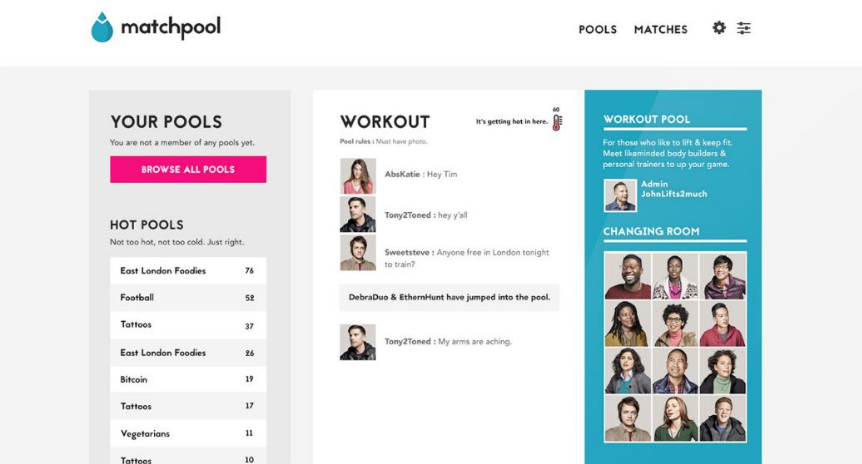
Matchpool is a decentralized matchmaking protocol which utilizes group diversifications to assist participants match with each other. It is also used as a generic platform for any membership in the society which defines two sides of the market or exchange of goods and services. Pooling refers to bringing people or ideas together to achieve common goals and objectives. Matchpool refers to bringing people with connections in one platform. Individuals need to subscribe for updates concerning matchpool news, team updates, investments, offers and developments in place.  
 

Matchpool technical aspects 

There are many dating sites that attemp to asist singles meet their other signifacant. Human relations on existing dating cites are not natural. Every interaction in the glob is based on trust. Matchpool deals with the initial lack of trust among individuals today. Its solves the difficluties where people could not open a niche dating site that targets the community. In addition it enables people to connect with minimum time possible. Through the trust of Matchpool, two strangers trust each other through trusting the matchmaker, which in means that the matchmaker monetize his matches without any difficulties. Moreover Matchpool is used for recruitment pools and have the same effectiveness.  

Matchpool review 

Consumers or end users in the platform can find linksto the application by joining the pools the best solve their needs. Cryptographic token, in the economy, will build the first platform for mainstream matching. Tokens will be purchased using money at various centers and also through online. Users across all platforms are rewarded automatically for their trust and commitment.  

Individuals can own their pool where manage and become a community. The owner sets their terms and rules considering that they are themselves, managers. Matchpooling can be spread to various sectors including health, education, recruitment, lifestyle, business, clubs, and dating. Online dating applications utilize models that do not satisfy the users. Dating applications focus on keeping the user on the platform to maximize revenues other than cater for their customers. 

Matchpool Crowdsale

Matchpool users will divide into two catagories – Joiners & Hosts.
Joiners who wishes to enter a pool of their choice, will have to pay the pool's requisite entry fee, which will be defined at the creation of that Pool by the Pool's Host. In addition to this one-time registration fee, a monthly membership fee will be paid to the Pool. All payments will be held in an Ether based smart contract and will be processed using Matchpool's network own token Guppies (GUP). While in the Pool, nature will take its course and all members would be able to interact publicly on private channels in a way resembling Slack's interface. On the other side, users can also play the role of Hosts and Matchmakers. 

The host will be the one who opens a custom Pool and gets dividends from its revenues. Matchmakers or Helpers as they are defined in the system can propose matches between two other joiners who they believe would be good partners. Those two joiners are then notified and in case they both accept, the event is added to their public notebook, and the Matchmaker get rewarded. 

Matchpool - The future of dating

Both the Host of the pool and its matchmakers are entitled for shares of the Pools subscription and monthly fees, paid with GUP. Matchpool first 200,000 Users will get rewarded with GUPs upon registration enabling them to make their first steps in the platform. 

Dapplets

Dapplets are another way Matchpool users can get rewarded. These are basically add-ons created by developers who want add to the Matchpool protocol. In practice, Dapplets work similar to Slack plugins but can enhance the experience in a number of ways. One example would be a Dapplet, which implements "Tinder" functionality: users can swipe through other users. If one of their apps creates a match of some kind for example: if a "Blind Date" game creates a real match, then the Dapplet developers are rewarded similarly to Matchmakers. 

Issuance & Distribution


Matchpool - The future of dating


Matchpool - The future of dating 

Match pool is a decentralized matchmaking and dating protocol, which makes use of group dynamics in an effort to assist as many users as possible to find a partner. 

This platform consists of user-generated groups of people. These groups can be seen as a cross in between Meetup groups and Slack channels, invite-only groups whose ownership and management is done by users acting as matchmakers. When joining the platform, there will be rules that the user has to follow.

The Matchlock feature maintains an equal ratio between Y and X so that each and every pool in the site remains attractive. If a specific number of X users gets into the pool, then this feature will halt more X from getting into the pool until an equal number of Y's enter. 

The Matchpool app will have an interface at the front end that will allow users to look for favorable pools in different places that have interests that vary. As they start, users will be shown a list of pools in their place, which is consistent with their specific interests and demographics. 

There will be two categories of users in Matchpool. These will be hosts and joiners. Joiners who would like to get into a pool of their interest will have to pay a fee that should be defined at the creation of the pool by the pool's host. Additionally, a monthly membership fee is payable to the pool. Every payment made will be contained in a smart contract that is Ether-based. These payments will then be processed by network own Guppies belonging to Matchpool. Inside the pool, members will socialize publicly via private channels.

Users can also play the part of a matchmaker or a host. The host opens a custom pool and gets dividends from its fees. Helpers or matchmakers are able to propose a match between two joiners that they see as viable partners. The joiners get informed of this and in the event that they accept, the occasion is added to their public notebook, and the helper gets a reward. The matchmakers and host have an entitlement to the ownership of the subscriptions of the pool and monthly subscriptions paid with GUP. 

The first 200,000 users of Matchpool will get GUPs as a reward when they register. 

Dapplets is another form of reward. Dapplets implement "Tinder" function where swiping of users through other users is allowed. For instance, if a game of blind date brings about an actual match, then developers of the Dapplet are rewarded like Matchmakers. 

The platform will create a way for users to make money while having fun and finding love. Don't miss this great chance to become part of something great. 

Resources

Bitcointalk.org Annoucement 
Website 
Blog 
Twitter 


SINGAPORE -- March 21, 2017 -- The Qtum (pronounced "Quantum") Foundation (www.qtum.org) raised over $15 million in a record five days, listing the project among the all-time top 10 blockchain-token crowdsale campaigns. Qtum started the first day off fast, selling $10 million of its tokens in a mere 90 minutes. By comparison, Ethereum (now the #2 market cap in cryptocurrency with a valuation of $3.6 billion) took 42 days to raise $18 million.

The crowdsale, scheduled to last 30 days or until all tokens were sold, ended with the project raising over 11,000 bitcoins and 75,000 ether (ETH) in exchange for the 51 million Qtum tokens being distributed to the public. Instead of sending tokens to a single crowdsale address, Qtum enlisted six cryptocurrency exchanges/crowdfunding portals to conduct the sale in a coordinated fashion. The sites participating in the campaign were Bizhongchou (bizhongchou.com), Yunbi (yunbi.com), ICOAGE (icoage.com), Allcoin (allcoin.com), ICO365 (ico365.com), and BTC9 (btc9.com).

Qtum tokens (QTUM) are the cryptographic software tokens used to engage with distributed applications and smart contracts on the Qtum platform and will serve as the staking token for the Qtum blockchain, as well as fuel for computational operations performed by the Qtum network. Details on the Qtum concept can be found in the Foundation's white papers.

"We are confident that we can finish what we originally started a year ago. We hope our supporters can work with us to build the greatest blockchain platform for enterprise and consumer use cases. There are so many possibilities for the blockchain industry, with Qtum, we are just at the beginning of a long journey." – Patrick Dai, co-founder of the Qtum Project

The total QTUM token supply will be allocated in three primary ways. 51 percent of QTUM tokens (51 million) will be distributed through the now-completed crowdsale. Funds raised this way will finance the Qtum Foundation's operation for the next four years, including development, administration, marketing, and financial/legal consulting. Of the remaining 49 percent, 29 percent of QTUM tokens (29 million QTUM) will be allocated to community initiatives concerning business development, research, education, and market expansion. 20 percent of QTUM tokens (20 million) will be distributed among founders, early backers, and the development team. Further details are outlined in the Foundation's governance white paper. 

"Since we began this project, I have been excited about its premise. Now, this excitement has been validated and shared by thousands of backers. Qtum will bring about a new blockchain and smart contract revolution and will bring together the many disparate communities into one common goal of action." - Jordan Earls, co-founder of the Qtum Project

Qtum recently announced that one of the leading professional service providers, PwC, will support Qtum's efforts to help fuel blockchain adoption across global business sectors. Qtum has previously raised $1 million from investors including Chen Weixing (Founder of Kuaidi), Star Xu (CEO of OkCoin), Anthony Di Iorio (Founder of Ethereum & Jaxx Blockchain Interface), Jeremy Gardner (co-founder of Augur), Bo Shen (Fenbushi Capital's Managing Partner), Roger Ver (First Investor in Bitcoin Companies), and Xiaolai Li (blockchain angel investor).
 
For more information on the QTUM, please visit: https://qtum.org

About Qtum
Qtum is a hybrid blockchain application platform. Its core technology combines a fork of bitcoin core, an Account Abstraction Layer allowing for multiple virtual machines, including the Ethereum Virtual Machine (EVM), and a Proof-of-stake Consensus protocol, aimed at tackling industry use cases. The Qtum Foundation, headquartered in Singapore, is the decision-making body that drives the project's development. The Qtum Foundation has engaged one of the world's leading professional service providers, PwC, for project management support. Learn more at https://qtum.org
Company contact: john@qtum.org


Qtum - Blockchain made ready for business


In this fast-paced world where technology is making great advancements with new applications popping up every now again, you are probably trying to understand the connection between Bitcoin, Blockchain and QTUM. Allow us to explain these terms and how they are connected. 

Blockchain has now gone from being just a technology for Bitcoin to something so much more, as many in the industry are coming up with different systems based on it. Blockchain became popular when Bitcoin was first introduced several years ago, to help consolidate different databases into one that can be shared by multiple users, allowing them to make revisions as well as access it simultaneously, regardless of where they are. Furthermore, these databases are completely open to the public, giving all users access to the information and records contained therein. This has made this technology of great value as most have never seen anything like it before. This feature of the network ensures that it is also impenetrable, as a hacker cannot find its' nucleus to hack into. In the same gist, developers have now come up with a new application called QTUM (knows as Quantum).  

QTUM, based out of Shanghai, China essentially works by using the best of technologies from both Bitcoin and Ethereum ( programming language), so as to combine the two to get a platform that can work by producing decentralized applications. It introduces an element of 'smart contract' through the Ethereum Virtual Machine (EVM} on the one hand, and 'master contract' on the other. The aim behind this is to reduce the reliance of business on humans, thereby also reducing human error and other complications that may arise while tracking business transactions using the Blockchain database. They hope to do this by enabling the programs to run independently without requiring any sort of guidance. Although it seems like it will be awhile before business owners actually start using this model, QTUM will soon be released in beta.  

The QTUM Project

The QTUM Team 
FLTR; JOHN SCIANNA, BRETT FINCARYK, NEIL MAHI, PATRICK DAI, YUNQI "CASPAL" OUYANG, JORDAN EARLS


As to how efficiently QTUM will work can be gauged by the continuous success of Bitcoin since it first made it's debut in 2008. There have only been minor complaints about the digital currency and its' usage. This fact alone should silence the critics about the feasibility of this Blockchain-incorporated technology. However, the critics would watch to see how successful the technology is, as EVM and Bitcoin are known to not be compatible with each other. The question is as to whether these issue will be resolved. The support that the technology has already received from gurus in the industry is testament to the fact that this is indeed a revolutionary concept. In its' completed form, QTUM will be available for use not only on laptops but will also be available on mobile devices. 


Jordon Earls, lead developer / co-founder of Qtum

Was kind enough to answer some questions for us


Q. What are the strength and weaknesses of the project? And where do you see threats for Qtum? 
A. One of our strengths is that we know who we are targeting to use our blockchain and we have the right backers to make the connections we need. 

Qtum is being built with compatibility with existing economies and ecosystems in mind. This primarily is focused on Ethereum and Bitcoin. However, we are building what we would consider to be the best of both worlds. Taking the simplicity of the account model for smart contracts, and the power of the UTXO model for the underlying blockchain. The UTXO model specifically has proven to be more scalable and more compatible with existing protocols. This includes the SPV protocol, which will be used to make decentralized and trustless light and mobile wallets and applications. We have extended this to also include smart contracts, so that for the first time it is possible to interact with smart contracts without using a centralized server or API. 

Because we are building this from some existing projects, we share some of their weaknesses as well, though we have implemented some things to reduce their impact. In Bitcoin, there has been debate over blocksize and various attacks by filling up blocks. We have alleviated this by making the block time faster, as well as allowing for slightly larger blocks. In Ethereum, there have been many attacks on certain opcodes which are cheaper than they should be. We have alleviated this by allowing for multiple gas "schedules" (gas price of each opcode) without any kind of forks. Although our aim is to build off of known secure and proven code, there is some new code as well that has not been proven (primarily the Account Abstraction Layer). We will be holding a bug bounty when we release the testnet to try to find and fix any bugs in this new code before we release the mainnet. 

We also see some threats from other community and consortium projects. But since this is largely an open-source community, we will all benefit from competition. We also seek to embrace other projects to bring the various disparate communities together into a common alliance. 


Q. You've raised 1M dollar with the help of Angel Investors. Now your seek 10000-15000 Bitcoins for future development. What are the consequences if this target is not reached? 
A. We will reserve any unsold coins to sell to institutional investors at a later date. The only real consequence is that we might have to take some time from focusing on the code to sell the remaining tokens to people who will use them in our network. Finally, we have plans for what happens if we do not raise as much as expected now and later, and it just means we might drop lower-priority optional projects for Qtum. However, we do not expect for this to be a concern at this point. 

Q. In what regard do you consider Qtum different from The Stratis project? 
A. I don't know enough about Stratis to comment on it.

Q. In which field will Qtum excel? I.e. onto which market next to the finance will the most marketing resources targeted to? 
How do you see companies active in that market implement Qtum to their products. A. Some of our largest backers see Qtum playing just as large a role in IoT as it will in finance. When you think of the identity management systems that are needed for people, similar tools will be needed for a secured IoT. We can see these potentially on permissioned side-chains of Qtum. 

This is an enormous market for blockchain technology, and it is crucially needed. Last year we saw the largest DDoS attack ever done with unsecured CCTV cameras, we think blockchain technology can help mitigate these attacks to a large extent if we could pinpoint what devices are acting maliciously. The SPV protocol is our big strength that enables this to be done on small and lightweight devices that are not capable of downloading and processing the complete blockchain. 

Qtum is also built with mobile dApps in mind, decentralized applications running on the blockchain, but being interacted with and controlling traditional Android and iOS mobile applications. We believe that with this we can enable businesses to bring dApps to the consumer and other use cases previously out of reach by smart contract platforms. 

Q. Many (new) crypto projects use Blackcoin's POS implementation. Do you consider The Blackcoin project a competition? 
A. Blackcoin's PoS 3.0 implemented a lot of new features and fixed many of the attack vectors in PoS 2.0 and 1.0. We owe them credit for creating the PoS 3.0 implementation that we have ported to Qtum. However, we do not feel that Blackcoin (which is mostly still Bitcoin from a smart contract point of view, complete with all of the limitations, such as not being Turing-complete) is suitable for all of the goals we have for a smart contract platform. We would like to emphasize that we embrace our competition, and hope to build a large community bringing many different projects together. 


If you are tired of dealing with Wikipedia, Lunyr can do the trick. This decentralized encyclopedia can become your best friend when you need to find reliable information fast. We will let you know here what this service is all about, and you will also find a lot of interesting things here. 

Decentralized Encyclopedia

Lunyr is just a decentralized, crowdsourced encyclopedia that will reward you with app tokens when you just review an article or contribute information. The intention of the creators of this website is making Lunyr become a leader in the service of giving reliable, accurate information to the world. Developers all over the world will be able to use Lunyr`s API so they can create the next generation of useful and decentralized apps in augmented reality, virtual reality, artificial intelligence, and more. Lunyr truly wants to be the most important knowledge base in the future. This service is also free for everyone out there. 

The Lunyr Project

Incentivized Contribution

Since your contribution will be rewarded, you will love Lunyr right away. Users will read information for free all the time, and you can also peer-review a lot of articles right away. Centralized authorities will handle oppression and censorship right away, so you will manage to resist this problem right away. There is no central administrator for this amazing community, so you will be able to resolve qualities issues and disputes easier. There is no downtime here because the service is available on the famous Ethereum blockchain at all times. 

Now that you know more about Lunyr and the things this service can do for you, you have more reasons to feel optimistic about the future of our planet. You will manage to get a lot of rewards with Lunyr right away, and this will allow you to get another source of good things in your life quickly and easily. With Lunyr being a token of the Ethereum blockchain you will need to buy Ethereum for sending tokens. However Ethereum has proven to be the most advanced blockchain to date. And the Lunyr team made a wise choice using the possibilities of Ethereum.

About

Lunyr is an Ethereum-based decentralized crowdsourced encyclopedia which rewards users with app tokens for peer-reviewing and contributing information. We aim to be the starting point of the internet for finding reliable, accurate information. Our long-term vision is to develop a knowledge base API that developers can use to create next generation decentralized applications in Arti 

Resources

Announcement
Website 
Whitepaper

Milestones

The Lunyr Project
Mor


Online gambling was valued more than $40 billion in 2016. However, when you engage in online betting you have two main problems: Transparency and Price. There are unfriendly users rules, all players have to wait for payouts and gamble with more than 5% house edge. What is maybe most important is that players don't know what is going on inside the servers and how everything function and work. So that means that it could be rigged. Users must rely on the casino because cooperation is the only way to keep the customers happy and satisfied. 2008 was a great year for online gambling because Bitcoin casinos solved the gambling price problem. 

They offered instant money transaction with anonymity and small house edge. Crypto currency gambling has grown by 37% from 2015 and it has become the main choice for many online gamblers. But still, it has not solved the problem of transparency. The edgeless casino is the solution for your problems because it is the first casino with 0% edge with full transparency and possibility to increase your market shares in order to become a sustainable business. Edgeless betting is a form of gambling that uses 0% of house edge equation as a playing principle. 

How to make a profit by using Edgeless Casino?

There are several different ways to make Edgeless Casino profitable business. First, it provides you with games that depend on a combination of luck and skill and most important, sports betting. 

The difference between Edgeless and traditional casino:
• 0% house edge — Games are based on skill and luck, if you play perfect, you can have 0% edge gambling service. However, if you make the mistake that could give you a disadvantage.
• Instant and free money withdrawals — If you transfer your tokens to provide an instant money deposit or withdrawal you don't have to wait anymore for two days, everything happens instantly.
• Full transparency — It is based on number generator in Ethereum Smart Contact that is completely public. Everyone can see everything that is happening inside the servers.
• No registrations/logins for casino users and 100% anonymity — Wallets are anonymous and there are no any registrations because edgeless casinos protect your anonymity
Edgeless

Phases of Edgeless Casino Project:

1. In the first phase, you can engage in decentralized price pool with more than 40% of casinos profits. You have a chance to win EDG tokens, and to relocate your investments into a bankroll in order to pay out wins for the first wave.
2. The second phase is important because funds must be allocated into a prevention Edgeless Casino's bankroll in order to pay out larger wins. If the bankroll is increased, then the wager is bigger, too.
3. In the third phase, we can expect a development of a new game that is based on luck and skill, similar to black Jack and the game with micro limit dice.
4. In fourth, it is important to engage in sports betting scale that could provide you additional funds that could compensate your investment in order to stay competitive.
5. The Grand Vision is a platform where you can easily develop your own casinos in order to make an impact on casino industry all around the world.

The Crowdsale begins on February 28th at 3 pm GMT and in the first week you can expect for 1 ETH 1100 EDG, in second 1050 EDG and in the thirds one for 1000 EDG. 
US citizens are not legally allowed to participate in Edgeless Project crowdsale 

Resources

Bitcointalk.org 
Website 
Whitepaper


Although trading is difficult, it can also be profitable and it can be profitable for you, too- but if you're new to trading and only know the basics, trading can be tough as you are competing for profits against more experienced people. If you're stuck trying to trade or want some new tips to try out, you'll want to read the text below.

  1. Just like with gambling, do not trade more than you can afford to lose. Although trading can be profitable and easy money, it is also a little bit risky and you can sometimes lose a lot of your money. Apply the same rules in gambling in trading, like cutting losses, and you will be fine with trading; some of the most profitable cryptocurrencies to trade can be very volatile.

  2. If you don't know what you're doing, stop. Even if you only make a little bit of money doing what you know, stick with it until you can prove otherwise another method is more profitable and you are truly making more from it. As cryptocurrencies are very volatile, if you make a wrong step you could lose hundreds of dollars and you might never get those dollars back.

  3. Never store all of your money on an exchange, try to only keep the money you need to trade and nothing more on the exchange, and withdraw all of your profits as quickly as possible. If an exchange is hacked, the exchange is most times not liable for the damages that are caused, or they might only give you a small portion of stolen funds ( I.e Bitfinex- Bitfinex gave users who had stolen funds tokens that could later be exchanged back into bitcoin. The value of tokens fell sharply and most people only got a little bit of their original funds back). Although many exchanges claim to be completely safe and have the latest technology to keep your cryptocurrency safe, anything is hack able and you don't want to take that risk.

  4. If it seems too good to be true, it probably is. If you see a coin spiking in price or a good pattern to invest in, don't buy any of it. Don't buy into patterns that seem too good to be true or into an exchange that offers insane amounts of free money as a deposit bonus- chances are your money will be stuck in the exchange because of some kind of rule the exchange has set up. Make sure you are putting your funds into a good and legit exchange that has trust in the community and you should be just fine in terms of your money.

Exchanges

  • When it comes down on make sure you only keep coins there which you use for trading. Other coins should be sent to your own wallet, because after so many exchanges got hacked, there is never security as to how long you can trade on a certain exchange.
  • Stick to the main (larger) exchanges, again there is never a guarantee but avoiding exchanges who hide their identity; Yobit, C-Cex etc. will only give you a headache.
  • Trade in top 50 altcoins @coinmarketcap.com, smaller coins are often scams are overvalued projects (not all, but still).